
Showing posts with label Occupy Wall Street. Show all posts
Showing posts with label Occupy Wall Street. Show all posts
Wednesday, October 26, 2011


Tuesday, October 18, 2011
Quote of the Week
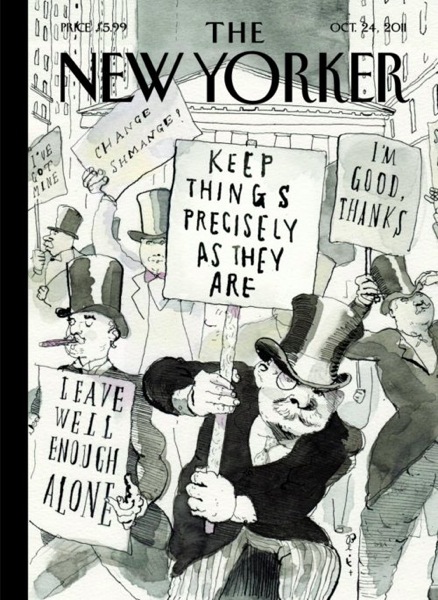
This week, as I often do, I'm going to cheat a bit on Quote of the Week, and use it as an excuse to post a pretty clever cover from the New Yorker, pertaining to Occupy Wall Street.
For Quote of the Week, we'll just go with the guy in the background with the "I'm good, thanks" poster. He's my favorite.
I think I'm gonna start to walk around carrying a sign that says "I'm good, thanks," just to see how people respond to me. Actually maybe I'll just print up some t-shirts. Who wants one?
For Quote of the Week, we'll just go with the guy in the background with the "I'm good, thanks" poster. He's my favorite.
I think I'm gonna start to walk around carrying a sign that says "I'm good, thanks," just to see how people respond to me. Actually maybe I'll just print up some t-shirts. Who wants one?
Monday, October 17, 2011
Interesting related graphics (and how they relate to Occupy Wall Street)
I've already posted Jon Stewart's terrific take on Occupy Wall Street here, and if you're looking for an equally well-executed (albeit much less humorous) summary of the situation, I'd suggest you read this piece from Barry Ritholtz. He correctly points the finger not only at Wall Street execs, but also at Washington, the mainstream media, and even the Supreme Court.
Ritholtz also warns that if the Occupy Wall Street movement isn't careful, it could suffer the same fate as the Tea Party--that is, being co-opted by a partisan political message that over-simplifies and distorts the original themes of the movement for the benefit of an established political party. In the initial stages of a movement or protest, disorganization doesn't really matter, but eventually it does--people (especially those in the media) are always looking for a coherent narrative, and they'll find it wherever they can.
At any rate, in that vein, I was struck by a couple of charts (appropriately enough, all brought to my attention by the very same Barry Ritholtz) that I came across this weekend, and they seemed both related and relevant. I'll leave the conclusions to you.
The first is a series of charts showing the changing distribution of income gains in the U.S. over the past century (culled from this interactive graphic).
Related to that is a graphic showing which Presidents were responsible for the majority of our country's debt accumulation. (Note: I always take these "debt by President" charts with a massive grain of salt, because it's always difficult--if not impossible--to properly assess "blame" to one President or another for certain long-standing projects or proposals. If TARP was passed by Bush but enacted under Obama's watch, who bears the brunt of that debt hit? What about tax cuts, and then the extension of those tax cuts? And do we give Obama a free pass for certain of his policies that are certain to create debt in the future, even if they haven't officially done so yet? As a result, the findings of these types of charts have a tendency to be... a bit inconsistent. But they're generally consistent in a range--like, it's indisputable that George W. accumulated significantly more debt than Clinton--if not in specific numbers and percentages. They're far from statistically perfect, and therefore heavily prone to statistical manipulation to suit the artists' needs. But if you appreciate that fact, they can still be interesting.)

Alright, that's it for now. That should at least help explain why so many people are so angry, and why they're out in the streets (that and the fact that they're unemployed and really have nothing better to do). Good times.

Ritholtz also warns that if the Occupy Wall Street movement isn't careful, it could suffer the same fate as the Tea Party--that is, being co-opted by a partisan political message that over-simplifies and distorts the original themes of the movement for the benefit of an established political party. In the initial stages of a movement or protest, disorganization doesn't really matter, but eventually it does--people (especially those in the media) are always looking for a coherent narrative, and they'll find it wherever they can.
At any rate, in that vein, I was struck by a couple of charts (appropriately enough, all brought to my attention by the very same Barry Ritholtz) that I came across this weekend, and they seemed both related and relevant. I'll leave the conclusions to you.
The first is a series of charts showing the changing distribution of income gains in the U.S. over the past century (culled from this interactive graphic).
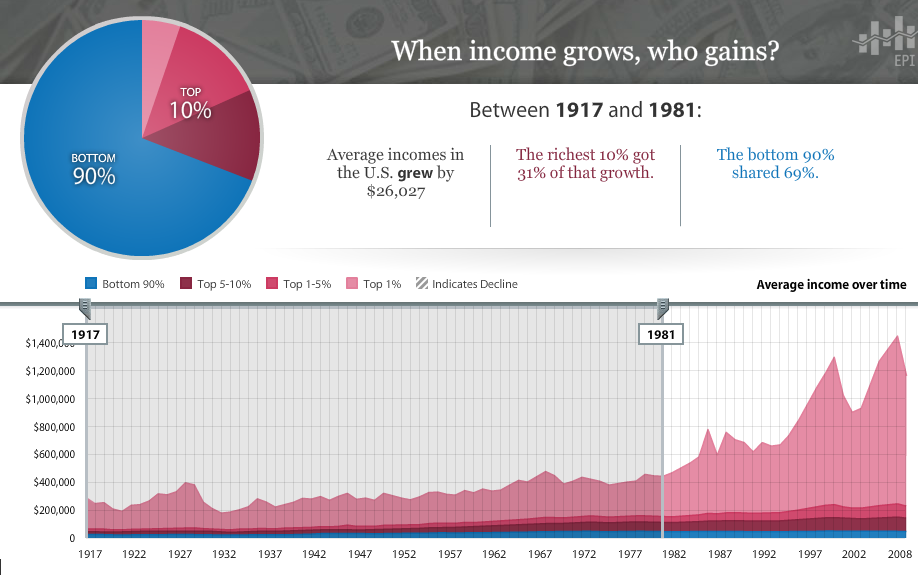 |
| Between 1917 and 1981, the bottom 90% received 69% of income gains. |
 |
| Between 1982 and 2000, the bottom 90% received just 23% of income gains. |
 |
| Since 2001, incomes for the bottom 90% have declined. The top 10% have still gained. |
Related to that is a graphic showing which Presidents were responsible for the majority of our country's debt accumulation. (Note: I always take these "debt by President" charts with a massive grain of salt, because it's always difficult--if not impossible--to properly assess "blame" to one President or another for certain long-standing projects or proposals. If TARP was passed by Bush but enacted under Obama's watch, who bears the brunt of that debt hit? What about tax cuts, and then the extension of those tax cuts? And do we give Obama a free pass for certain of his policies that are certain to create debt in the future, even if they haven't officially done so yet? As a result, the findings of these types of charts have a tendency to be... a bit inconsistent. But they're generally consistent in a range--like, it's indisputable that George W. accumulated significantly more debt than Clinton--if not in specific numbers and percentages. They're far from statistically perfect, and therefore heavily prone to statistical manipulation to suit the artists' needs. But if you appreciate that fact, they can still be interesting.)

Alright, that's it for now. That should at least help explain why so many people are so angry, and why they're out in the streets (that and the fact that they're unemployed and really have nothing better to do). Good times.
Monday, October 10, 2011
Jon Stewart on "Occupy Wall Street"
I haven't really been able to piece together my thoughts on the growing Occupy Wall Street phenomenon, and I'm certainly not alone. The difficulty in assessing this situation/movement/protest is that we all want it to be some cohesive, coherent, easy-to-categorize group, when in reality it's anything but--and that's exactly what makes it so important.
The fact is, the people of the Occupy Wall Street movement are exactly what they say they are--the "other 99%". And since we know that 99% of people can rarely agree on anything (the closest we've been able to get is, ahem, 89%), it's unrealistic and frankly stupid to expect this group to have one consistent message. They're not anarchists, they're not Nazis (fuck the heck, Ann Coulter?!?), they're not lazy and uneducated, and they're not hippies--although some of them are probably all of these things. The only thing these people have in common is that they're unemployed (or underemployed), pissed off, and tired of not having their voice heard. And that much I can certainly get behind (well, not the unemployed part... whatever, you get my point).
So let's leave it to Jon Stewart to explain the rest, because he does a pretty terrific job of showing just how absurd things can become when we try so hard to categorize the un-categorizable.
Ignore these people at your own peril. I have a feeling this group won't be quite as easy to co-opt into a political party as was the Tea Party.
The fact is, the people of the Occupy Wall Street movement are exactly what they say they are--the "other 99%". And since we know that 99% of people can rarely agree on anything (the closest we've been able to get is, ahem, 89%), it's unrealistic and frankly stupid to expect this group to have one consistent message. They're not anarchists, they're not Nazis (fuck the heck, Ann Coulter?!?), they're not lazy and uneducated, and they're not hippies--although some of them are probably all of these things. The only thing these people have in common is that they're unemployed (or underemployed), pissed off, and tired of not having their voice heard. And that much I can certainly get behind (well, not the unemployed part... whatever, you get my point).
So let's leave it to Jon Stewart to explain the rest, because he does a pretty terrific job of showing just how absurd things can become when we try so hard to categorize the un-categorizable.
Ignore these people at your own peril. I have a feeling this group won't be quite as easy to co-opt into a political party as was the Tea Party.
Subscribe to:
Posts (Atom)