This material isn't exactly new, but I just came across it and found it interesting and worth sharing. A few months back, self-described "writer, director, and producer" Kirby Ferguson started a web video series called "Everything is a Remix". The project has its basis in the concept that nearly all pop culture relies on a few simple themes and refrains, repackaged and repurposed and remixed to look like something different--"West Side Story" has the same basic plot as "Romeo & Juliet", "Clueless" is based on "Emma", the Blue Man Group is a total ripoff of the Smurfs... et cetera, ad nauseam.
At any rate, Part 1 of the series (posted below) was very well done, as is the recently-released Part 2.
As individuals and as a society, we always like to think of ourselves as unique, new, and important--hence the proliferation of "best (fill-in-the-blank) ever" (or "worst (fill-in-the-blank) ever") conversations and debates and lists. It can be humbling and somewhat depressing to admit that we are simply ordinary, or that we live in ordinary times--it is a perfectly human desire to at least want to be extraordinary.
I like to think of myself and my own life--my athletic accomplishments, my academic degrees, my job history--as unique, but all of my achievements are almost by definition derivative. At best, I am unique only in the specific ordering and packaging of those achievements--very little I have done is original, in fact (I'm certainly not the first hedge fund manager in history) or at least in theme (this blog, while "unique", is not realistically any different from anything that anyone has ever written before--the letters and words are just ordered differently and read by different people).
That recognition can be a very humbling thought, and it's not something that anyone seriously likes to think about. Thinking about it makes us feel small and insignificant in a world, universe, and history that is larger than we can possibly fathom. Since I've been sufficiently existential now for one day, I'll leave you to watch and ponder the video. Good talk.
[Everything is a Remix]
Monday, February 7, 2011


Am I the only one who missed this?
Like anything in politics, the latest maneuver out of Arizona is probably more posturing and smoke-and-mirrors than actual governance--style over substance as usual--but it nevertheless surprises me that it hasn't received more attention. From the Arizona Republic,
I am one of the first people to agree that our federal government has grown far beyond its original mandate, using the fine print of the Commerce Clause to legislate in areas that should probably be left to the states. However, our Constitution also enumerates a process for reviewing these laws, and that process certainly does not include a 12-member committee in Arizona. To subvert that process is to ignore the Constitution, and, as the Arizona Republic writer notes, to effectively secede.
In a different time, the proposal of a bill like this would have been scandalous enough to have generated a significant response across the country, possibly meaningful enough to have sparked a small-scale (if not outright) civil war. That it can fly so quietly below the radar, without much mention at all in the national media, shows just how far the level of discourse--not to mention political leadership--has fallen in our country. It may be apathy on the part of the citizens, or simply bad government across the board. But given recent events in Arizona, it surprises me greatly to see this kind of event escape notice.
[AZCentral.com]

Members of the state Legislature, including Arizona's de facto governor, Senate President Russell Pearce, have introduced a bill that essentially would have Arizona secede from the union without having to do so officially.
Really.
It's called SB1433, (See it here.) It creates a 12-member committee within the legislature that could "vote by simple majority to nullify in its entirety a specific federal law or regulation that is outside the scope of the powers delegated by the people to the federal government…"
Committee members themselves would decide this, then pass along their recommendation to the full Legislature. If, in turn, a majority of state lawmakers go along with the committee then, according to the bill, "this state and its citizens shall not recognize or be obligated to live under the statute, mandate or executive order."
Basically, our friends in Arizona are trying to take it upon themselves to perform the duties that are Constitutionally delegated to our Supreme Court.The nullification committee also would be permitted to review all existing federal laws to see if our legislative geniuses want to toss them out as well.
I am one of the first people to agree that our federal government has grown far beyond its original mandate, using the fine print of the Commerce Clause to legislate in areas that should probably be left to the states. However, our Constitution also enumerates a process for reviewing these laws, and that process certainly does not include a 12-member committee in Arizona. To subvert that process is to ignore the Constitution, and, as the Arizona Republic writer notes, to effectively secede.
In a different time, the proposal of a bill like this would have been scandalous enough to have generated a significant response across the country, possibly meaningful enough to have sparked a small-scale (if not outright) civil war. That it can fly so quietly below the radar, without much mention at all in the national media, shows just how far the level of discourse--not to mention political leadership--has fallen in our country. It may be apathy on the part of the citizens, or simply bad government across the board. But given recent events in Arizona, it surprises me greatly to see this kind of event escape notice.
[AZCentral.com]

Friday, February 4, 2011
More on Super Bowl ads
I posted yesterday about my favorite Super Bowl ads from the past couple of decades, and with Fox set to rake in about $300 million in ad sale revenues this Sunday, it was an appropriate time for the folks over at Slate to discuss banned Super Bowl commercials, and whether they might be a better business decision for the companies in question than actually running an ad during the game itself (spoiler alert: yup).
This dynamic adds another interesting angle to the way that social media and the internet is challenging the traditional advertising world, and more fundamentally reshaping the way that consumers relate with the brands whose products they buy.
Large, expensive, mass-media advertisements that generate massive amounts of impressions and raise general brand awareness are not the slam-dunk they were once perceived to be. In the age of Google AdSense and AdWords, targeted advertisements with high conversion rates are gaining a significant amount of traction. Super Bowl ads are still a lucrative business for the networks involved, but the higher the price tag, the more companies will start to look for other ways to get their customers' attention.
[Slate]
(h/t Deadspin)
This dynamic adds another interesting angle to the way that social media and the internet is challenging the traditional advertising world, and more fundamentally reshaping the way that consumers relate with the brands whose products they buy.
Large, expensive, mass-media advertisements that generate massive amounts of impressions and raise general brand awareness are not the slam-dunk they were once perceived to be. In the age of Google AdSense and AdWords, targeted advertisements with high conversion rates are gaining a significant amount of traction. Super Bowl ads are still a lucrative business for the networks involved, but the higher the price tag, the more companies will start to look for other ways to get their customers' attention.
[Slate]
(h/t Deadspin)
Thursday, February 3, 2011
Clip of the Week
Since it's Super Bowl week, and we all miss the days when Super Bowl commercials really were better than the game (which probably said more about the games back then than the commercials, but so be it), I thought I'd use this week's Clip of the Week to honor some of the best Super Bowl ads of all time.
I'm not old enough to remember Mean Joe Greene, so his commercial doesn't count, and neither does Troy Polamalu's remake. And there were a lot of good ones that didn't quite make the cut here--like this one, this one, this one, this one, and of course these ones.
But for me, there are two that clearly stand out above the pack.
First, there's this one, for its sheer stupidity and awesomeness. Also, its subtle poking fun at the insanity of the tech bubble and the massive amounts of wasted money earn it bonus points. Thirdly, monkeys.
Second, there's this one. Terry Tate needs no introduction.
Enjoy the game.
I'm not old enough to remember Mean Joe Greene, so his commercial doesn't count, and neither does Troy Polamalu's remake. And there were a lot of good ones that didn't quite make the cut here--like this one, this one, this one, this one, and of course these ones.
But for me, there are two that clearly stand out above the pack.
First, there's this one, for its sheer stupidity and awesomeness. Also, its subtle poking fun at the insanity of the tech bubble and the massive amounts of wasted money earn it bonus points. Thirdly, monkeys.
Second, there's this one. Terry Tate needs no introduction.
Enjoy the game.
Gender inequity at Wikipedia
There's a fairly interesting discussion (basically, four op-ed columns on the same topic) over at the New York Times regarding gender inequity within the Wikipedia community. According to the Times, fewer than 15% of Wikipedia contributors are female, a staggeringly low figure. The question posed in the discussion is why?
There are a couple of interesting answers, which I'll excerpt below. From Carnegie Mellon professor Justine Cassell:
But I also think there's a missing variable here, one that the other two Times debaters also miss. This Times item from 2008 describes at length the factors behind the significant lack of women who choose to major in (or specialize in, or pursue careers in) computer science. Frankly, the world of I.T.--and by extension the internet itself--tends to be dominated by men. They are more comfortable on the whole designing, editing, and contributing to tech-heavy forums, of which Wikipedia is essentially one.

The factors for this disparity aren't particularly well understood, but discussing and analyzing them is essential to understanding and unlocking the puzzle of gender inequity at Wikipedia. I was surprised to see no mention of this disparity in the Times debate, and I think that the discussion therefore suffers. The most famous and successful internet sites (Google, Facebook, Yahoo!, Amazon, YouTube, Twitter, eBay), not to mention broader technology companies (Microsoft, Apple, Dell, Hewlett-Packard) were unanimously founded by men, and there are few if any examples of technological companies founded--or even managed--by women. This dynamic stands in stark contrast to many other areas of business and industry--sure, gender inequity exists elsewhere, but rarely to such a drastic degree.
I think this is the real reason behind the male-centric nature of Wikipedia content creation. For whatever reason, women are reluctant to dive into the guts of the technology they use--perhaps they are being discriminated against, perhaps there are cultural explanations, and perhaps there are...genetic explanations (how you doin', Larry Summers). The only certainty is that to understand Wikipedia, we need to start at a much higher level, and try to decipher the dynamic that drives technological innovation in our country and the world.
[New York Times]

There are a couple of interesting answers, which I'll excerpt below. From Carnegie Mellon professor Justine Cassell:
From the inside... Wikipedia may feel like a fight to get one’s voice heard. One gets a sense of this insider view from looking at the “talk page” of many articles, which rather than seeming like collaborations around the construction of knowledge, are full of descriptions of “edit-warring” — where successive editors try to cancel each others’ contributions out — and bitter, contentious arguments about the accuracy of conflicting points of view. Flickr users don’t remove each others’ photos. Youtube videos inspire passionate debate, but one’s contributions are not erased.
Despite Wikipedia’s stated principle of the need to maintain a neutral point of view, the reality is that it is not enough to “know something” about friendship bracelets or “Sex and the City.” To have one’s words listened to on Wikipedia, often one must have to debate, defend, and insist that one’s point of view is the only valid one.
There is, therefore, a certain disparity between the public goals of Wikipedia — to make all knowledge available to all people through a social and collaborative process of knowledge construction -- and the private practices of Wikipedia, where one truth may have to be defended against opposing points of view, and one’s words may need to be protected against others who seek to wipe them out.Her take, then, is that many women shy away from the chest-thumping and competitive nature that seems to dominate the Wikipedia culture. Along a similar line of reasoning, author Joseph M. Reagle opines that:
First, a culture of hacker elitism can be unappealing to those unable or unwilling to hew to the stereotypical features of the hacker (i.e., a singular, narrow focus; argumentative style; and geek image). Also, the openness of such communities means that a minority of high-conflict members (including, for example, a misogynist or an Internet troll) can have a disproportionate effect on the tone and dynamics of the community.
Finally, the ideology and rhetoric of freedom and openness can then be used (a) to suppress concerns about inappropriate or offensive speech as "censorship" and (b) to rationalize low female participation as simply a matter of their personal preference and choice.
I think these communities are undergoing some difficult but necessary growing pains. As "locker-room" type behavior is challenged (e.g., inappropriate images in conference presentations and sexist jokes), I hope this will make way for more inclusiveness and good faith collaboration -- something which Wikipedia has many great examples of already.I think there's some fair points in Reagle's analysis. Wikipedia is, in many ways, like an overgrown "Comments" section of a blog. Spend enough time trolling the comments sections of blogs, and it's easy to be turned off by the overwhelmingly crass nature of the "conversation"--in no small part aided by the anonymity (whether real or perceived) of blog commenting. At the risk of sparking a gender war of my own here, I'd say that it's no small leap to assume that women--on the whole--could be more sensitive to this type of "locker room" behavior than men would be.
But I also think there's a missing variable here, one that the other two Times debaters also miss. This Times item from 2008 describes at length the factors behind the significant lack of women who choose to major in (or specialize in, or pursue careers in) computer science. Frankly, the world of I.T.--and by extension the internet itself--tends to be dominated by men. They are more comfortable on the whole designing, editing, and contributing to tech-heavy forums, of which Wikipedia is essentially one.

The factors for this disparity aren't particularly well understood, but discussing and analyzing them is essential to understanding and unlocking the puzzle of gender inequity at Wikipedia. I was surprised to see no mention of this disparity in the Times debate, and I think that the discussion therefore suffers. The most famous and successful internet sites (Google, Facebook, Yahoo!, Amazon, YouTube, Twitter, eBay), not to mention broader technology companies (Microsoft, Apple, Dell, Hewlett-Packard) were unanimously founded by men, and there are few if any examples of technological companies founded--or even managed--by women. This dynamic stands in stark contrast to many other areas of business and industry--sure, gender inequity exists elsewhere, but rarely to such a drastic degree.
I think this is the real reason behind the male-centric nature of Wikipedia content creation. For whatever reason, women are reluctant to dive into the guts of the technology they use--perhaps they are being discriminated against, perhaps there are cultural explanations, and perhaps there are...genetic explanations (how you doin', Larry Summers). The only certainty is that to understand Wikipedia, we need to start at a much higher level, and try to decipher the dynamic that drives technological innovation in our country and the world.
[New York Times]

Wednesday, February 2, 2011
Late challenger for Quote of the Week
I gave a nod to Brett Keisel yesterday for his quote at Super Bowl Media Day, but then Chuck Schumer came along and issued the face-slappingest quote of the year so far. Far be it from me to deny the good senator his time in the limelight.
This week's NOT-QUITE-QUOTE OF THE WEEK
"We have three branches of government. We have a House, we have a Senate, we have a President. And, all three of us are going to have to come together and give some."
-New York Senator Charles Schumer
Video here (at the 1:09ish mark):
Hey, Chuck, phone call for you: it's Roger Vinson. He says, "up yours". So does John Roberts.
This week's NOT-QUITE-QUOTE OF THE WEEK
"We have three branches of government. We have a House, we have a Senate, we have a President. And, all three of us are going to have to come together and give some."
-New York Senator Charles Schumer
Video here (at the 1:09ish mark):
Hey, Chuck, phone call for you: it's Roger Vinson. He says, "up yours". So does John Roberts.
Tuesday, February 1, 2011
Quote of the Week
Apologies for the lack of posting today--was feeling under the weather all day. Speaking of weather, how you doin', Chicago?
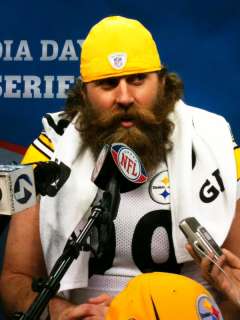
But it was Media Day for the Super Bowl down in Dallas, which means no shortage of options for this week's Quote of the Week. I'm going to give it to Steelers defensive end Brett "The Diesel" Keisel, whose awesome playoff beard is stealing the show.
This week's QUOTE OF THE WEEK
"There are not a lot of jobs in America that would let you come to work looking like this."
-Steelers defensive end Brett Keisel

But it was Media Day for the Super Bowl down in Dallas, which means no shortage of options for this week's Quote of the Week. I'm going to give it to Steelers defensive end Brett "The Diesel" Keisel, whose awesome playoff beard is stealing the show.
This week's QUOTE OF THE WEEK
"There are not a lot of jobs in America that would let you come to work looking like this."
-Steelers defensive end Brett Keisel
Subscribe to:
Posts (Atom)