Showing posts with label Labor. Show all posts

Wednesday, July 11, 2012

The downside of homeownership

In an article this week, The Economist wonders whether the decreasing labor mobility in the United States—which I've covered here before—is a result of a "more efficient market". They write,
The drop in mobility shows up almost exclusively in gross migration, the total number of interstate household moves... The trend predates the housing boom and bust; the crisis cannot explain it.
Some reckon the decline is caused by demography. Young workers, at the start of their working life, have most to gain from moving. An ageing population may therefore be less mobile. Growth in two-earner households could also play a role. When both partners work, it is harder to move if one of them loses his job or is offered a post somewhere else. New research by Greg Kaplan of the University of Pennsylvania and Sam Schulhofer-Wohl of the Federal Reserve Bank of Minneapolis casts doubt on these explanations...
The authors analyse census data gathered monthly between 1991 and 2011, and find that the pattern of falling mobility persists across all parts of the workforce. Mobility is down across “all education levels, for people of all marital statuses, and for both single-earner and multiple-earner households.” Ageing is a red herring: mobility rates have dropped most for young workers. It isn’t so much the American worker that is changing, they argue, but the American economy. Reduced mobility largely reflects two shifts in the nature of economic activity...
The first is that the mix of jobs offered in different parts of America has become more uniform. The authors compute an index of occupational segregation, which compares the composition of employment in individual places with the national profile. Over time, their figures show, employment in individual markets has come to resemble more closely that in the nation as a whole. 
This homogenisation reflects the rising importance of “non-tradable” work. As the name suggests, non-tradable goods and services are not traded across long distances. Californian dentists tend not to clean Floridian teeth; every city has its own dentists. Cars, by contrast, are tradable, so not every state has its own car plant... With more of the country’s employment mix present in each state, it is less necessary to move to find work.
... The authors suggest another force is also reducing migration: the plummeting cost of information.
Young workers in particular used to have to move to gather information: to see whether they could stand a Boston winter, say, or cared enough about the Californian climate to pay Californian rents. In recent decades, however, it has become much easier to learn about places without moving house. Deregulated airlines and innovative online-travel services have slashed travel costs, allowing people to visit and assess different markets without moving. The web makes it vastly easier to study every aspect of a potential new home, from the quality of its apartment stock to the surliness of its baristas, all without leaving home. Falling mobility isn’t simply caused by labour-market homogenisation, the authors argue, but also by greater efficiency. People are able to find the right job in the ideal city in fewer hops than before.
These explanations are, in theory, quite compelling. It's certainly interesting that labor mobility is falling the most among younger workers, and this does indeed seem to beg an explanation beyond just the housing bust and underwater mortgages.

Nevertheless, I can't help but think that the housing dynamic—or, at least, the wider debt bubble that fueled it—has a significant role to play here, if only indirectly. Might it be that young workers, overly burdened with student loan debt and unable to afford places of their own (either to rent or to buy), are shacking up with their (perhaps underwater) parents so as to avoid rent costs? Clearly these two dynamics can play off of each other, given that they both stem from the same basic problem of overwhelming debt, leading workers of all ages to stay closer to home.


In thinking through these problems, I was reminded of this blog post from Tyler Cowen from last month. Citing a study in El Pais, Cowen writes:
Here are the European countries with the highest owner occupancy rates:
1. Romania, 97.5%
2. Lithuania, 93.1%
3. Croatia, 90.1% 
4. Slovakia, 90.0%
How about the lowest rates?
1. Switzerland, 44.3%
2. Germany, 53.2%
3. Austria, 57.4%
Get the picture?
Cowen's point is clear. For years—decades, even—we heard politicians and economists touting homeownership as an integral part of the American dream, and a huge key to our future economic success as a nation. Now, we're starting to see the flip side of that coin, and we're not alone. The most prosperous nations in Europe in fact have very low homeownership rates, while the nations with high rates flounder. This absolutely cannot be a coincidence, and it must have at least something to do with labor mobility.

That, or a high homeownership rate is just a great indication of a society with a lot of debt, a lack of flexibility, and therefore a general lack of entrepreneurship. I hope that we won't some day be reading statistics similar to Cowen's list there regarding levels of college education, but I certainly have to wonder. Debt is an ugly beast, and we can't very easily explain it away by spitballing theories about "lower costs of information". It's a good effort by The Economist, but I remain unconvinced.

[The Economist]
[Tyler Cowen]

Monday, December 13, 2010

A follow-up on labor force participation rates

Last week I penned a rather long post about our falling labor force participation rate, and the prolonged pain for the official unemployment rate that that rate seems to predict. I came across a chart that shows an interesting opposite side to the labor force participation coin. What I focused on in my previous post was the "Male, 25-54" demographic, which represents a significant portion of our typical work force. This piece from Tim Iacono takes a look at the very different dynamic within the 55-64 age group.

The report came to my attention via the WSJ Economic Blog’s Number of the Week as some 1.6 million Americans are believed to have put off retirement due to falling asset prices. It’s amazing to think back just a few years when people actually believed that, not only was their rising home equity going to pay for vacations, new cars, and other stuff they really didn’t need, but it was also going to pay for their kids’ college and their own retirement.
Yup, these are indeed strange times we live in. Younger people are so discouraged that they're leaving the work force in droves, while the older generation is so discouraged and/or uncomfortable that they can't afford to do the same (and retire). As always, it'll be interesting to see how this chart plays out over the next couple of years.


[The Mess That Greenspan Made]

Tuesday, December 7, 2010

Jobs and the participation rate

Last Friday's jobs report for the month of November was massively disappointing, with an uptick in the unemployment rate showing that we have much work left to do before we can declare this recession "over" (oh, I forgot, we already did... whoops).

Of course, this report was used by politicians as an excuse to push more stimulus, which was effectively done last night with the "temporary" extension of all Bush-era tax cuts combined with a further extension of unemployment benefits. Nobody seems to wonder or care how we will pay for the additional $700-$900 billion in deficits (depending on the estimate) that these policies promise to create over the next two years, but that's a topic for a different post.

The focus of today's post is to discuss the severe structural problem in our labor market, and why our effective unemployment rate is in fact much higher than even the latest 9.8% figure suggests. I've mentioned before, if briefly, that the effective unemployment rate has edged as high as 17%--a staggering figure by any definition. What accounts for the difference? This:

As our friends over at the Calculated Risk blog show us, the labor force participation rate has plummeted to an all-time low for the Male 25-54 demographic, a key group because it represents such a large portion of the overall labor force.

What does this mean? It means that for various reasons, discouragement or otherwise, a significant portion of our usually productive workers have been classified as "not looking for work", and therefore are not counted in our core unemployment rate--if you're not looking for a job, you're not officially unemployed. As a result, overall labor force participation has dropped from 66.2% in May 2008 to 64.5% now, the lowest rate since 1984.

There are two ways this can go from here, and neither is particularly good for the economy. Either these men stay unemployed forever, meaning that there will be fewer productive workers in our economy--and therefore fewer bodies feeding more mouths (think Social Security is insolvent now? Just wait)--or else they start looking for work at some point in the future, meaning that our unemployment rate (as reported by the government) will remain stubbornly high for some time.

In other words, the more jobs we create, the more jobs we will need to create in order to keep our unemployment rate constant, as more Americans "rejoin" the labor force. It's a simple but disturbing math problem, with a couple of moving variables. We certainly shouldn't wish for the labor participation rate to stay low (it's a baaaad sign for the economy if it does), but it's the only possible way to keep our reported unemployment rate low. We need to wise up and realize that the real unemployment rate is indeed much closer to the 17% number than the 9.8% number, and ask ourselves whether our ongoing "stimulus" is doing any stimulating at all. Because according to these charts, we've got a long and ugly road ahead of us.

That second chart, courtesy of Zero Hedge, projects that on our current stimulus-aided path, we won't recover our pre-recession unemployment levels for another 5 years. What's even worse is that this line assumes zero growth in the aforementioned labor force participation rate. A return to a more "normal" participation rate would extend the pain for another 50-60 months, meaning that pre-recession employment levels would not be met until some time in 2019. A lost decade, indeed.

I don't honestly know what the best way out of this mess is, but I am confident that continuing to play "extend and pretend" with unemployment benefits--while making Devil's bargains like last night's bipartisan "compromise"--will only prolong the inevitable. We need to revamp our education system and do whatever we can to encourage entrepreneurship and small business growth (no, not through tax incentives, we need to be much more creative and transformative than that), whether by citizens or by immigrants (yes, immigration policy is a part of this too, and no, not in the ways that the rhetoric would make you think).

We need to admit that we have a problem, and that blind government spending will not solve it, at least not quickly (see you in 2020) or without creating a host of other debt-related problems. We need to step up and create jobs for ourselves, which means taking a hard look at how we actually provide value for each other in our communities. Either that, or we can just all become farmers again, feeding ourselves with the fruits of our own labor. Whatever works.

[Calculated Risk]
[Calculated Risk]
[Zero Hedge]

Friday, November 5, 2010

The Crimson Cavalier's first (but not last?) guest post...

Since launching my blog earlier this fall, I've had it in mind to invite and allow the occasional guest post on my page. I certainly don't pretend to have a monopoly on ideas (or anger), and this being a democracy, I'm more than willing to let another voice be heard every once in a while. With over 100 posts under my belt, I decided to take a break for a bit today and let somebody else do some talking.

Am I just getting lazy on a Friday and shirking my responsibility as a blogger? Maybe. Would the President and Congress scold me for outsourcing my labor to a foreign body? Probably. Am I going to protect the guest poster by masking his/her identity and promote journalistic integrity by posting his/her words without editing (except for punctuation, where I'm a stickler)? Absolutely.

So, enjoy. You don't have to agree with the poster's words (just like you don't have to agree with mine) or his style (no cartoons or humorous pictures? What the hell!), but as I said--this here is a democracy. And if you ever feel like submitting a guest post of your own, don't be afraid to ask. I'd be more than happy to outsource some more labor. So without further ado...

FREE MARKETS 1, UNIONS 0
by "Tom Glavine"

Originally, I had my sights set on the irony (many of you wouldn't know real irony from crappy happenstance) of AARP's lauding Obamacare and being instrumental in its passage, only to reveal months later that:
In an e-mail to employees, AARP says health care premiums will increase by 8 percent to 13 percent next year because of rapidly rising medical costs.
The problem with tackling that article is that it is too easy--Obamacare is so fatally flawed that trying to attack it would be akin to slapping around a 90-year old man with Stage IV cancer who has lost most of his limbs from either sepsis or diabetes.

So instead I will be taking on the behemoth that is unionized labor (cue climactic music here... DUN DUN DAHHHH!)--in my humble opinion the prime modern-day example of a wonderfully-intentioned idea being utterly gang-raped by human nature and its proclivity towards avarice (yes I used a thesaurus to find a word that meant extreme greed).

Labor unions were formed during the industrial revolution as a response to the abuse of low-skilled factory lemmings (workers) by factory owners. Their initial mission was to maintain or improve the conditions of their employment. This was soon expanded to include more social reforms like the institution of public education and the adoption of universal manhood suffrage.

Setting aside the history lesson for a second here, the beginning of the unions in America brought about fantastic change and allowed for less slave-like conditions in some respect. However, once labor laws were enacted on a national level, we began to see the hideous transformation of unionization into the beast it has become today. Following the enactment of effective labor laws, unionized labor should have fallen by the wayside--but greed and corruption took over, and the result is horrible squeezes on corporations like you will read about below (Spoiler alert!! This story might have a happy ending, depending on which side you are on).

My muse for this story was a wonderful article in a small Midwest newspaper called the Belleville News Democrat, whose headline read "Olin to move 1,000 jobs to Mississippi (easy to spell out loud, much harder to type quickly) after union says no to new contract".
EAST ALTON (Illinois)-- After union workers employed at Olin Corp. voted against a new contract for the second time in as many weeks, the munitions manufacturer announced Wednesday that it will pull the trigger and move those jobs to Mississippi.
Now, at first blush, you may think that this is quite the tragedy--a company who has long been an employer of workers in the Midwest, leaving to head south where labor is cheaper. Or, in a second vein, one could lament the loss of 1,000 jobs at the hand of the evil corporate power. I, however, wanted to know more (unlike most Americans, who are too busy, lazy, stupid--pick one--to read more than the headline and first paragraph). So I kept going, and found this gem (emphasis mine):
Company employee Andy Lucker, who has worked at the East Alton plant for the past year and a half, said the contract that he and other union workers were presented Tuesday was the same on that they voted down over two weeks ago. He said the concessions included eliminating workers' HMOs, getting rid of a fifth week of paid vacation, a seven-year wage freeze, and a reclassification of some jobs.
This is one of those times where I wish there was a way to SUPER BOLDFACE something so that I could truly express my shock and outrage for this particular piece of text that horrified me as much as watching the Budd Dwyer suicide video (do yourself a favor, trust me, and do not look that up). FIVE WEEKS OF VACATION!! Let me express that in a different way--10% of the time that you are being paid to work, you are not working.

The article continues, explaining that the reason for the vote against the concessions--which came Tuesday via a 593-470 margin was that:
...most workers refused to accept concessions because they believe the munitions manufacturer has been profitable.
God forbid a company AND its labor union both make money! The union was merely trying to squeeze every ounce of profitability from the company and for ONCE, one of the key functions of an efficient market reared its head: PRICE DISCOVERY. The union presumed that it had more bargaining power (collective or otherwise) than it actually had. I wonder how many of these union workers thought they had Olin over a barrel.

Now they know...

I guess you can't have your cake and eat it too.


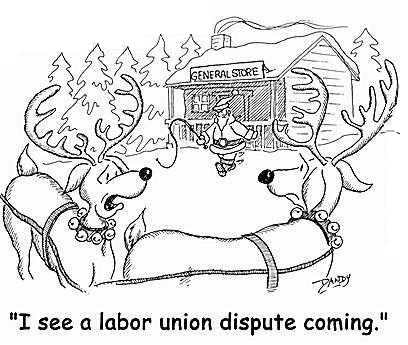
Thanks to the guest poster for nearly-unprecedented candor, anger, and just a hint of condescension. And, just for good measure... I'm gonna throw in a cartoon just for kicks.